


Spindle motor are the heart of every modern woodworking line. They power routers, saws, drills, and sanding units — and they are expected to operate flawlessly, day after day, in an environment that is anything but friendly to precision mechanics. When a spindle motor fails in such an environment, it is not just one machine that stops. The entire production line comes to a halt.
What our spindle motor service for woodworking covers
- Diagnostics with vibration and temperature measurements
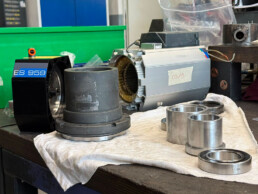
- Cleaning and inspection of internal components
- Replacement of all bearings and seals, including the refurbishment of bearing seats and shafts through welding and grinding where necessary
- Custom manufacturing of new parts; where original spare parts are no longer available or are damaged beyond repair, our designers create a 3D model of the component, which is then milled on a 5-axis CNC machine; every newly manufactured part is validated with measuring devices before assembly
- Winding inspection with resistance measurement and insulation testing; rewinding is only recommended when measurements indicate it is necessary
- Rotor balancing before and after assembly
- 5–10 hour bearing run-in with temperature monitoring (~55°C) and vibration analysis (mm/s and RMS gSP relative to RPM)
- Final test run with a documented service report
Why woodworking is a particularly demanding environment for spindle motors
Woodworking presents challenges for spindle motors that are not found in metalworking. Wood dust is omnipresent—it penetrates every gap, settles on the windings, clogs cooling channels, and, combined with moisture, forms pastes that cause overheating. When processing softwoods and MDF boards, the dust is particularly fine and invasive. In the case of resinous woods—such as pine, spruce, or exotic species—resin builds up on the bearings and shaft, accelerating wear.
Overheating is the most common consequence seen in the woodworking industry. A motor whose cooling system cannot dissipate heat because it is clogged with dust operates under constant thermal stress. The winding insulation gradually degrades, and bearings are subjected to excessive loads. The consequences first appear in the quality of the finish—and only then in a total motor failure.
Uncompromising precision
Spindle motors for woodworking operate at high speeds — often between 18,000 and 24,000 RPM. At these speeds, any irregularity that would be negligible at lower RPMs becomes critical.
Bearings, housings, and shafts
Replacing bearings in a spindle motor is not the same as replacing bearings in a general industrial motor. We replace all bearings and seals without exception—regardless of the visible condition of an individual element, as wear is not always visible to the naked eye.
Before installing new bearings, we inspect and measure the bearing seats and the shaft. Where we detect wear or deviations from tolerances, we weld and grind the seats back to the specified dimensions. This step is crucial—a new bearing will not sit correctly in a worn seat, meaning it will wear out faster and the spindle’s precision will not be achieved. By refurbishing the seats, we ensure the new bearing operates under the conditions for which it was designed.
Bearing preload must be set within narrow tolerances: too low, and the rotor has play, which manifests at high speeds as vibration and poor surface quality; too high, and friction generates heat, shortening the lifespan of the bearings.
Rotor balancing
Bearing replacement must be followed by rotor balancing — first independently, then across the entire assembly during operation. An unbalanced rotor at 20,000 RPM creates forces that the naked eye cannot detect, but every machined surface will. Scratches, waviness, and inconsistent cut profiles are often the first signs that something is wrong with the spindle — and that the service was not performed with sufficient precision.
Post-assembly measurements
After the service intervention, measurements of radial and axial forces as well as vibrations must be performed, and these must remain within the limits specified by the manufacturer. Without these measurements, it is impossible to guarantee that the motor will actually operate according to specifications once returned to the machine.
We have heard from clients who previously took their motors to other service providers that they seized upon startup because the bearings simply hadn’t been run in long enough to seat properly. Such a failure at the first startup is no coincidence. It is the predictable consequence of a skipped procedure.
Bearing Run
A Step Many Skip
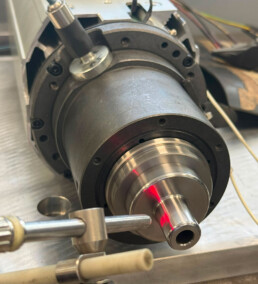
Newly installed bearings must be gradually warmed up and loaded under controlled conditions before the motor returns to full operation. At Matris, every spindle motor undergoes a 5 to 10-hour bearing run-in after servicing—depending on the motor type and cooling method.
We pay special attention to motors without water cooling. These heat up faster during operation, so we continuously monitor the external temperature of the motor during the process. When it reaches approximately 55°C, we turn the motor off and let it cool down before continuing. We repeat this cycle until the bearings settle and the operating temperature remains stable within acceptable limits.
In parallel, we constantly measure vibrations—both in mm/s and RMS gSP units—and compare them with permissible values based on the motor’s operating RPM. Only when the vibrations are within the prescribed parameters and the temperature is stable do we deem the motor fit to be returned to the customer.
Winding
Inspection and Protection Based on Cooling Type
In a woodworking environment, the winding is exposed to a combination of factors rarely encountered elsewhere: dust, moisture, resin vapors, and temperature fluctuations. Over time, the insulation gradually weakens, resistance between phases increases, and the motor becomes less reliable.
During every service, we thoroughly inspect the winding by measuring resistance and performing an insulation test. Only the result of this test determines if intervention is necessary. If the measured insulation values are above acceptable parameters, we leave the winding alone—no intervention is required, and it is not charged. If the values fall below the acceptable limit, we suggest a rewind to the customer.
Winding impregnation is not always appropriate and is not automatic. Woodworking spindle motors often have air cooling, where air circulates directly through the interior of the motor—in such motors, impregnation would block the cooling channels and cause overheating. Every decision regarding winding treatment is based on measured values, not assumptions.
What distinguishes quality service from a superficial one
The difference between quality and superficial service often does not show immediately. After a superficial service, the motor starts and runs — only to return weeks or months later with symptoms that are often worse than the original ones.
Superficial service
- Bearings replaced without tolerance measurements
- Preload estimated by eye
- Balancing skipped
- Run-in procedure omitted
- Winding not impregnated
- No documentation
Quality service at Matris
- Every bearing seat measured before assembly
- Preload measured and set to specification
- Rotor balanced before and after assembly
- 5–10 hour bearing run-in with temperature and vibration monitoring
- Winding inspection included as standard; impregnation where design permits
- Service report with measurements
Downtime costs: why prevention matters
In the woodworking industry, machine time is literally money. When a spindle stops, revenue stops. The time until the next service after a failure is not measured in hours, but often in days.
Preventive spindle motor service—planned in advance and performed during a controlled downtime—is a significantly cheaper option than an unexpected failure. A high-quality service performed to specifications extends the life of the bearings and windings, reduces the risk of failure, and returns the motor to a condition that guarantees machining quality.
Are you having issues with a spindle motor?
Contact us; we respond within 24 hours. With over 20 years of experience in the field of spindle and servo motor service, we are one of the few service centers in the region that services spindle motors through the entire process — not just by replacing the bearings.
Specialising in well-known motor brands


Connect with us
Visit us
Jelenčeva ulica 1
4000 Kranj
Slovenia
Google map
Working hours
Monday to Friday
from 7. until 15. hours