



Since our last participation at Hannover Messe 2025, the Matris team has been very busy. This year, we are returning with a new range of motor families and can’t wait to share the results of our work with engineers, OEMs, and system designers who will be at the fair in April.
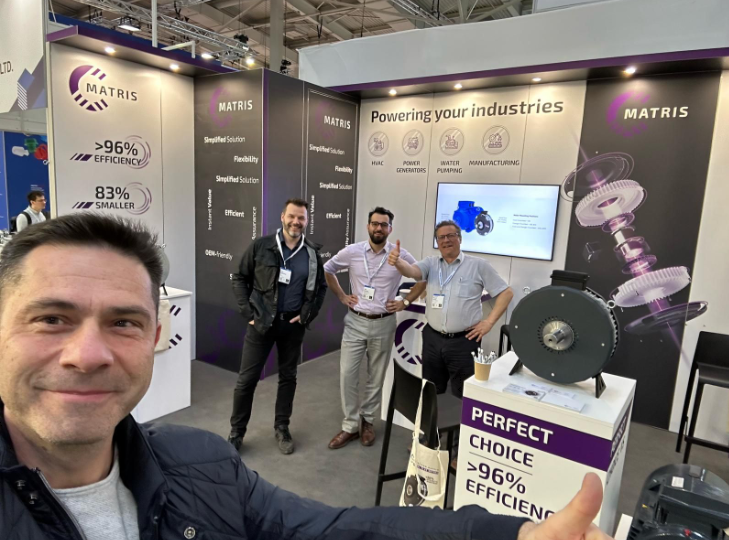
The Matris team at Hannover Messe 2025 exhibition grounds
Designed for OEM applications
The range we developed was not created on a whiteboard. It was shaped by areas that repeatedly emerged in conversations with engineers and OEMs. In particular, interest came from OEM manufacturers of industrial compressors and HVAC systems, where the compactness and efficiency of our motors open up entirely new horizons.
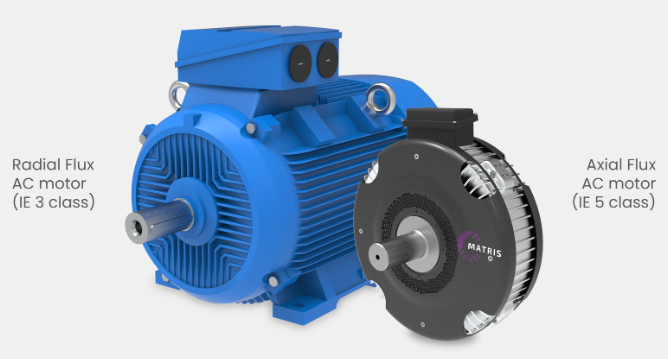
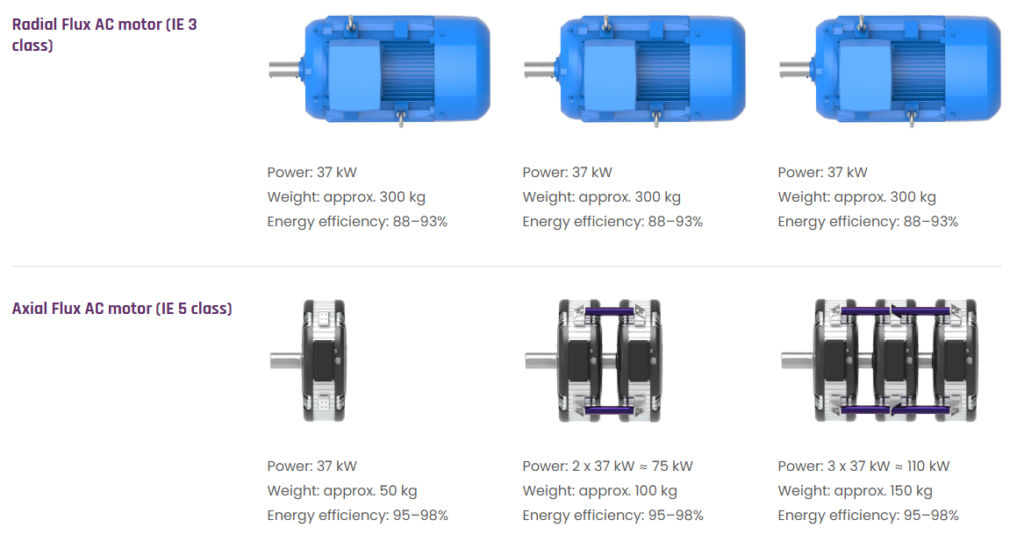
In HVAC systems, one of the often-overlooked limitations is simply physical: weight. Equipment on building rooftops is limited by the structural load-bearing capacity, and compactness and mass are constraints that cannot be ignored. Our axial flux motors are significantly lighter than comparable radial flux alternatives, which directly reduces the load on the roof, while the motor’s efficiency greatly reduces energy consumption. For building designers and HVAC engineers working within the limits of existing infrastructure, this is a practical advantage that has a measurable effect already in the design phase. At the same time, the end-user sees significantly lower monthly energy costs, which is becoming increasingly crucial in today’s world.
For industrial compressors, the importance of energy efficiency is, of course, equally significant. At the same time, it is also worth considering that compressor units are inherently large devices — long, heavy, and space-intensive. The axial flux design of our motors allows for a significantly shorter axial length compared to conventional motors of equivalent power. In practice, this means shortening the overall length of the compressor unit by at least a quarter. For industrial facilities where every square meter of floor space is valuable, and for applications where the compressor is integrated into a larger system, this difference is noticeable in both installation and maintenance.
Beyond IE5 — measured and validated
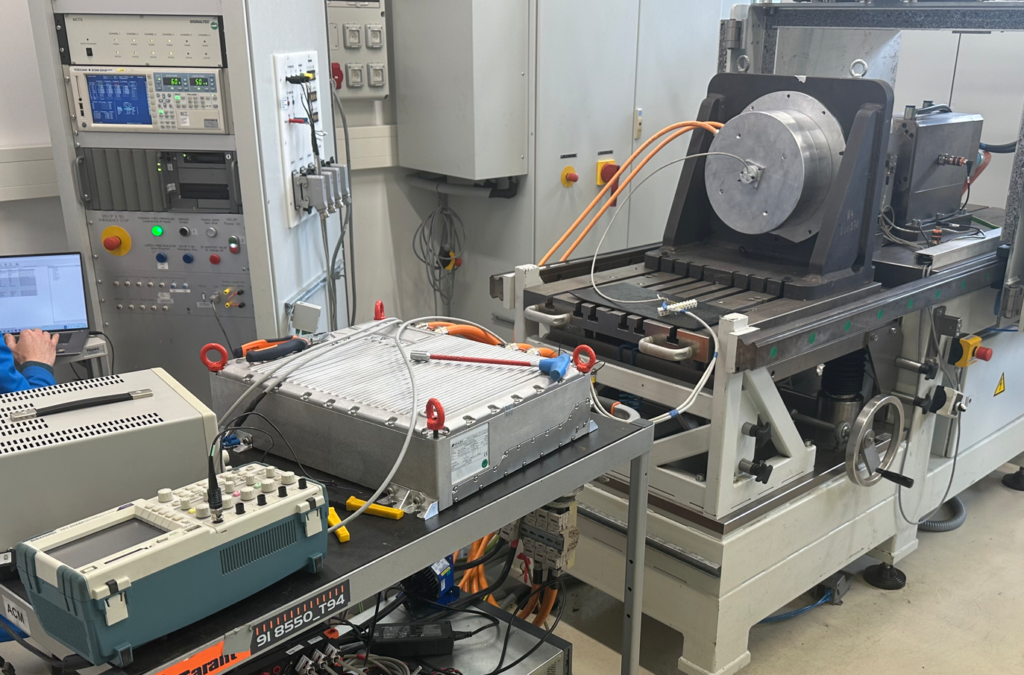
We set a clear efficiency goal: to exceed IE5, the Ultra-Premium class defined in IEC 60034-30 and currently the highest class in the international standard. We have now confirmed this through an independent testing laboratory.
Nevertheless, we do not consider this an upper limit. We are confident that even better results can be achieved, and work is already underway. The starting point has been established, and the direction is clear — IE5 is just the beginning.
Efficiency testing of Matris axial-flux motor at an independent testing laboratory.
Where we see the greatest application potential
In addition to compressors and HVAC systems, two areas stand out as particularly interesting to us.
In data centers and AI infrastructure, the high energy density of modern computing systems forces engineers to meticulously review every load in the facility. Cooling systems and auxiliary systems, once considered solved problems, are back on the table — and the need for ultra-efficient motor technology has never been greater.
We see similar potential in wastewater treatment, where motors operate at high utilization rates continuously, 24 hours a day, and where cumulative efficiency losses are directly and continuously reflected in operating costs. Marginal improvements in motor efficiency, multiplied by numerous devices operating for years, are not marginal in their overall effect.
Mechanical design: designed for integration
The motors are air-cooled. There is no need for additional liquid cooling infrastructure, which significantly simplifies integration in a wide variety of installation environments. Of course, a water-cooled design is also possible, but at least for now, we have not seen much interest in that direction.
The shaft is adjustable — available in extended or hollow versions, depending on the requirements of the driven system. This is a detail that is important in practice: the ability to adapt the shaft geometry to the application without additional engineering work removes obstacles in the integration process.
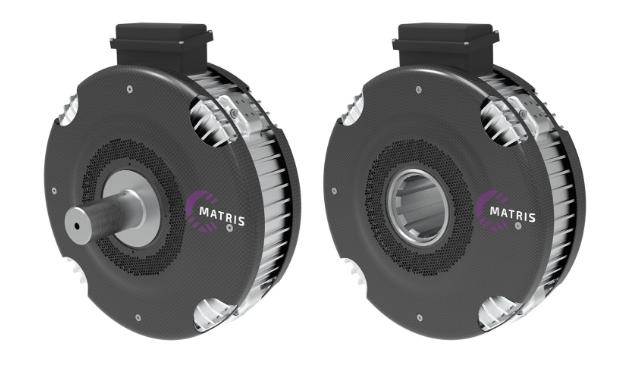
For applications requiring more power than a single unit can provide, up to three motors can be combined to incrementally increase output power. This means system designers can achieve higher power values modularly, without ordering a special high-performance design and its associated lead time and costs.
Let us meet in Hanover
If you will be attending Hannover Messe in April 2026 and would like to arrange a time at our booth, or if you are currently evaluating motor technology and would like to speak before the trade fair, please contact us directly. Free visitor tickets are available upon request.
 info@matris.eu |
  +386 4 29 26 900