


On the winding bench this week are a stator with a 310 mm diameter and a stator with an 800 mm diameter. The smaller one sits inside the larger one. Both came in for the same reason: the winding no longer holds.
Eight hundred millimetres is the stator diameter including the coolant housing. That is not a detail worth skipping, because this housing is what provides almost all of the cooling on these motors.
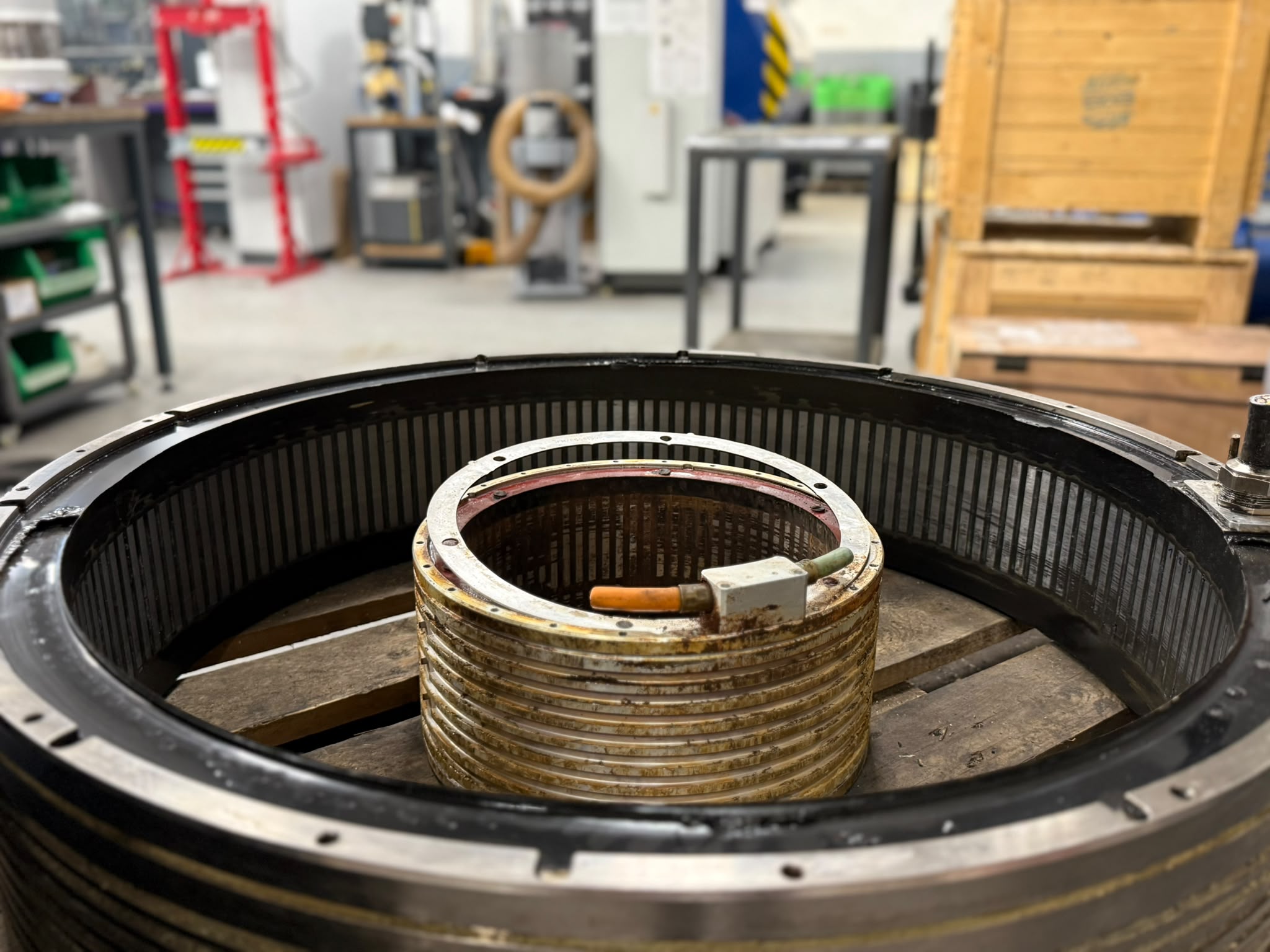
A 310 mm stator sits inside an 800 mm stator.
Direct drive means a different load
A torque motor is driven directly. There is no gearbox, no belt, speeds are low, there are many poles, and torque comes from diameter, not speed. As a result, currents are high—and they remain high even when the axis is barely moving or is stationary and simply holding position.
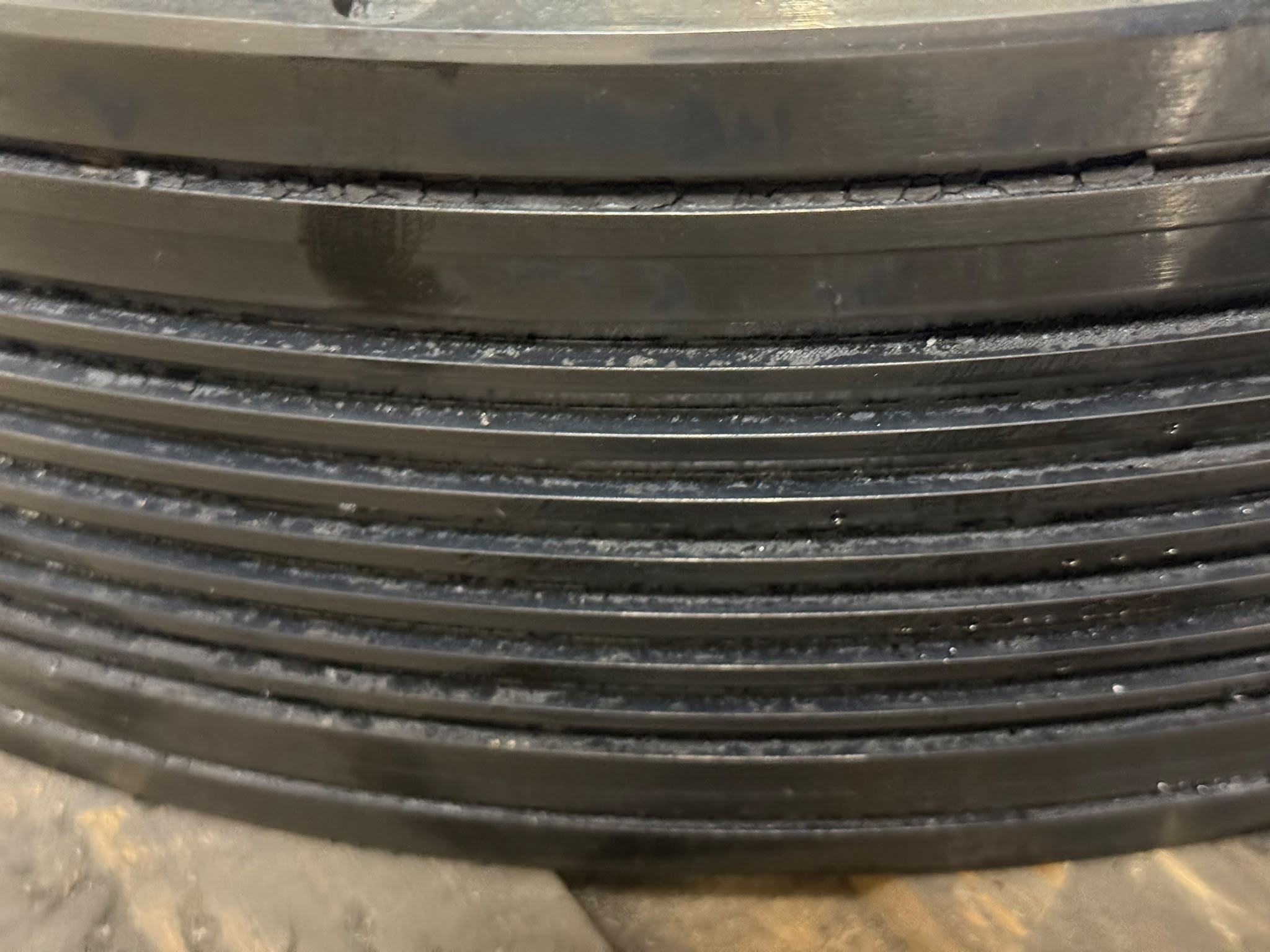
Cooling channels in the stator housing, close up.
A spindle motor overheats because it spins. A torque motor heats up because it holds.
The first assumption is almost always wrong
When we get a call about a failed torque motor, the first assumption is almost always mechanical. Something gave way at speed. But with direct drive, there is no such speed.
What actually ends up on our bench points elsewhere:
- long hours at high current, often without true rotation,
- a cooling channel that has to do its job for years, not months,
- adhesive and insulation that have been through many thermal cycles.
The winding is usually where the fault shows up. It is not necessarily where it started. That distinction matters, because after rewinding the motor goes back into the same machine, the same cooling circuit, and the same duty cycle.
Size is a question of its own
With an 800 mm stator, the technical part of the conversation starts only after the logistics: how to load it, how to lift it, whether it fits through the door, whether it can be set on the winding bench, whether it fits in the oven, and whether it fits in the epoxy bath.
At large diameters, this is not a side issue. Many workshops that can do the winding cannot accept a piece of this size, and the machine therefore sits idle longer than it should.
What can be measured—and what we do not promise
Rewinding a torque stator is the same as with a spindle motor—only everything is larger:
- new copper wire,
- epoxy over the entire stator, not only over the winding heads,
- insulation measurement before dispatch; the printout goes with the stator,
- no-load run, without load,
- 12-month rewinding warranty.
What we can document is the measured insulation. What we can measure on the rotor is the magnetic field.
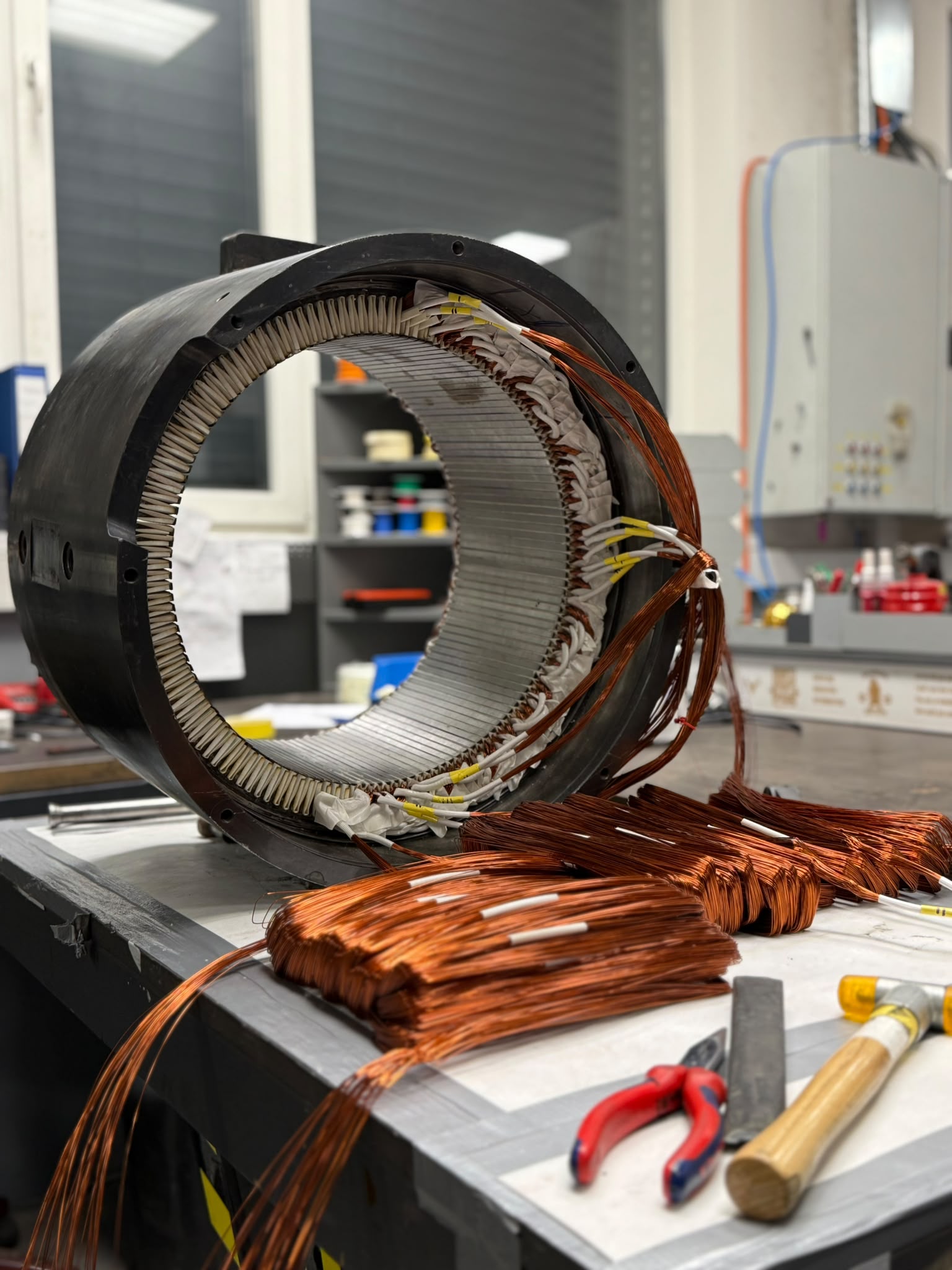
Rewinding a torque stator—the winding before insertion into the slots.
We do not test under load, and we cannot provide a torque curve after rewinding.
Data to capture before you remove the winding
Winding data for these motors is often not available. What is worth knowing about the winding is recorded in the winding itself—and only while it is still in place. Once the stator has been cleaned, there is nothing left to inspect.
That is why we photograph and measure every stator before removing the winding. With torque motors, this is not caution—it is the only source of data that makes it possible to produce the new winding at all.
Where the limit is
Torque stators come in very different sizes, and size is most often the reason a repair gets stuck somewhere along the way.
When we receive an enquiry, what we want to know first is not the motor brand, but the diameter, the stack length, and whether the housing has a cooling channel.
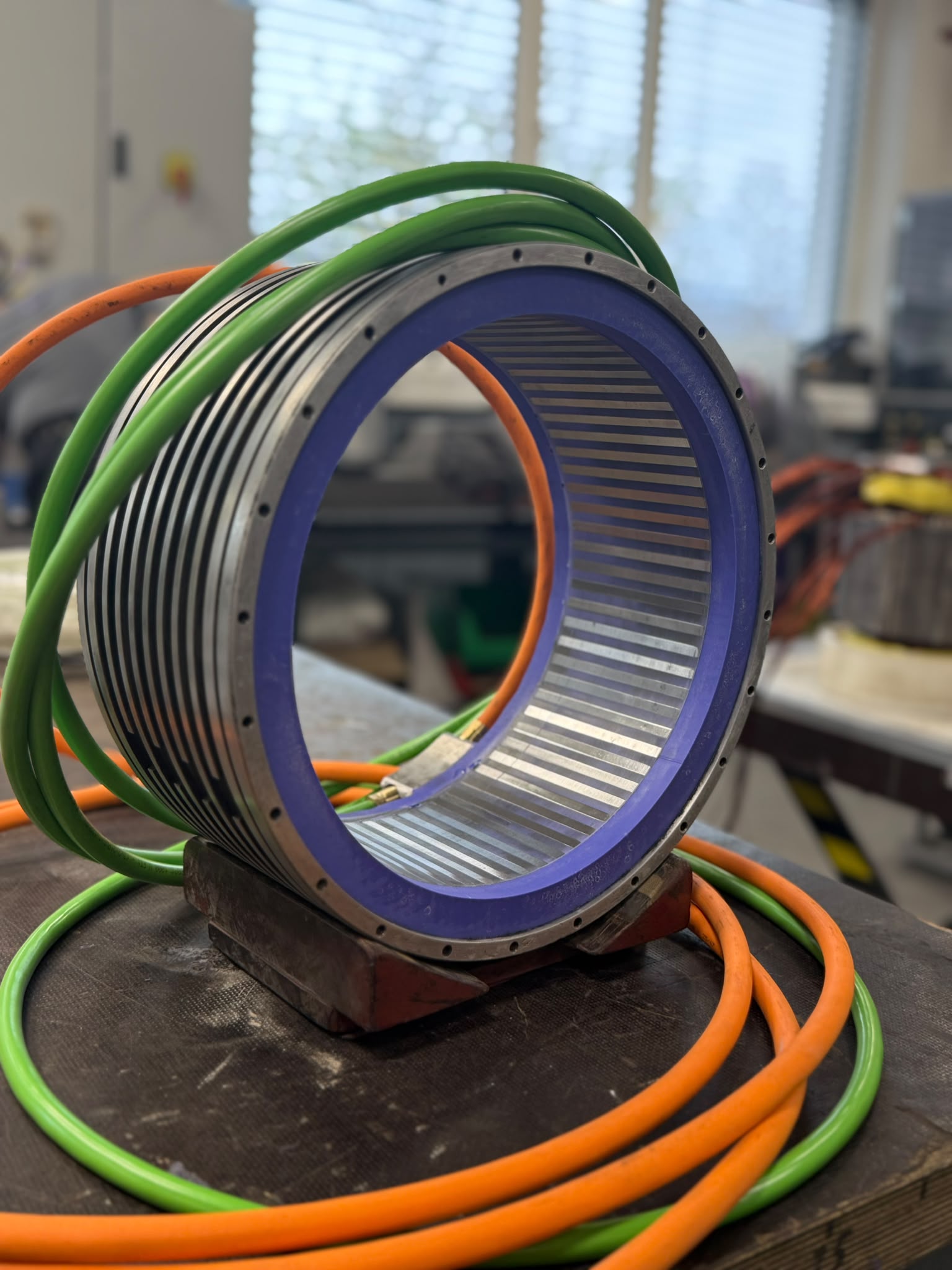
A rewound torque stator. This is a different motor, not the one in the photo above.
Do you have a torque stator with nowhere to send it?
We rewind torque and spindle motor stators for service companies and maintenance teams across Europe. Send the diameter, stack length, and photos of the part. If we cannot take the part, we will tell you immediately.
Frequently asked questions
No. We run the motor at no load, without load, and we do not provide a torque curve after rewinding. We measure and document the insulation, and the magnetic field on the rotor.
The diameter and stack length, photos of the part from all sides, and the nameplate data, if it is on the part.
With these motors, there often is none. We take the data from the existing winding before we remove it, which is why we photograph and measure every stator beforehand.
12 months on the rewinding.